





LaGuardia Airport: The Complete Guide to New York’s Transformed Gateway
For decades, LaGuardia Airport occupied a peculiar place in the American travel psyche. It was simultaneously the most convenient airport for millions of New Yorkers and a punchline for late-night comedians. Travelers loved its proximity to Manhattan but lamented its outdated facilities, confusing layout, and the infamous “third-world airport” label that stung local pride. Then came the transformation. Today, LaGuardia Airport stands as one of the most remarkable infrastructure success stories in modern American history, having undergone a complete rebirth that replaced nearly every terminal, reimagined the passenger experience, and restored dignity to a critical transportation hub. This comprehensive guide explores everything you need to know about navigating, enjoying, and understanding the new LaGuardia Airport.
Whether you are a first-time visitor to New York, a seasoned business traveler, or a local resident planning your next trip, mastering the ins and outs of this complex airport can significantly reduce stress and enhance your journey. The new LaGuardia Airport is not merely a collection of gates and runways; it is a showcase of what happens when thoughtful design, modern infrastructure, and a commitment to passenger experience converge. From the soaring skylights of Terminal B to the unified terminal complex that finally connects all facilities, this guide will walk you through every aspect of the airport, providing insider knowledge, practical tips, and strategic insights to ensure your time at LaGuardia is as seamless as possible.
The Remarkable Reinvention of LaGuardia Airport
The story of LaGuardia Airport’s transformation is one of ambition, frustration, and ultimately, triumph. For years, the airport operated with a fragmented terminal configuration that required passengers to exit security and re-enter if connecting between certain airlines. The terminals were cramped, the ceilings were low, and the overall infrastructure was simply not designed for the volume of passengers the airport served. In 2015, the Port Authority of New York and New Jersey unveiled a sw
eeping redevelopment plan that promised to replace the aging facilities with a unified, state-of-the-art airport. What made this project extraordinary was the commitment to building the new facilities while keeping the airport fully operational, a logistical challenge that required precise coordination and significant patience from travelers.
Today, the results are undeniable. The new LaGuardia Airport features a stunning Terminal B that opened in phases between 2018 and 2022, along with a completely rebuilt Terminal C that consolidated Delta Air Lines’ operations into a modern, expansive facility. The signature
element—a soaring, light-filled departures and arrivals hall—has transformed the arrival experience from one of dreary corridors to a moment of architectural delight. The airport now operates with a unified terminal structure connected by a centralized parking garage and pedestrian walkways, eliminating the old system where travelers had to brave the elements between terminals. This reinvention has garnered international acclaim, including being named the best new airport terminal in the world by Skytrax in 2023, a testament to how far the facility has come.
Navigating the Terminal Layout and Airline Assignments
Understanding which airlines operate from which terminals is essential for a smooth experience at LaGuardia Airport. The airport now primarily functions with two main terminals, Terminal B and Terminal C, which together serve all commercial airlines. Terminal B is the larger of the two and serves a diverse mix of domestic and international carriers, including American Airlines, United Airlines, Southwest Airlines, JetBlue Airways, Air Canada, and several others. This terminal is divided into two concourses, B1 and B2, which are connected airside after security, allowing passengers to move freely between gates without re-clearing security. The terminal also houses the airport’s main arrivals area and is where most international flights arrive.
Terminal C, meanwhile, serves as the dedicated home for Delta Air Lines and its SkyTeam partners. This facility is a massive, modern complex that consolidated Delta’s previous operations from Terminals C and D into a single, streamlined facility. The terminal features 37 gates across two concourses, with a centralized check-in hall that ranks among the most spacious in the country. Passengers flying Delta or Delta Connection should proceed directly to Terminal C,
is accessible via its own entrance off the Grand Central Parkway. A critical point to note is that while Terminal B and Terminal C are connected by a walkway and the airport’s central parking garage, they are not connected airside, meaning passengers connecting between airlines in different terminals must exit security, travel between buildings, and re-clear security at the new terminal.
Transportation Options to and From the Airport
Getting to and from LaGuardia Airport has historically been one of the more challenging aspects of using the facility, but recent infrastructure improvements have expanded options significantly. For decades, taxis and rideshares were the primary modes of
, leading to notorious traffic congestion on the Grand Central Parkway. Today, travelers have more choices than ever, each with distinct advantages depending on your destination, budget, and timeline. The new LaGuardia Airport is now served by the Q70 LaGuardia Link bus, which provides free, dedicated service between the airport and the Roosevelt Avenue/74th Street subway station in Jackson Heights, Queens. This bus operates frequently and uses dedicated bus lanes for much of its route, making it one of the fastest options for reaching the subway system.
For those preferring private transportation, traditional yellow taxis remain readily available with flat fares to Manhattan, while rideshare services like Uber and Lyft operate from designated pickup zones at each terminal. The introduction of a centralized pickup system has helped reduce congestion by directing passengers to specific waiting areas rather than allowing curb crowding. Additionally, several private car services and shuttle companies offer advance booking options, which can be particularly valuable for early morning departures or when traveling with significant luggage. Travelers should also be aware that parking at the airport is available through a centralized parking garage that connects directly to both Terminal B and Terminal C, offering both short-term and long-term parking options with pre-booking available online.
Inside Terminal B: Architecture, Amenities, and Operations
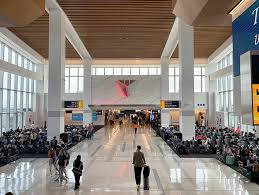
Terminal B at LaGuardia Airport represents the centerpiece of the airport’s transformation, and stepping into its main hall is an experience that immediately signals a departure from the airport’s past. The terminal, designed by the renowned architecture firm HOK, fe
tures a sweeping, undulating roof that rises to create a light-filled space spanning over 1.3 million square feet. The departure level is organized around a central check-in area with self-service kiosks and full-service counters arranged intuitively by airline. Perhaps the most striking feature is the departure hall’s dramatic window wall facing the airfield, allowing natural light to flood the space while offering views of aircraft operations. This connection to the outdoors was a deliberate design choice intended to reduce the claustrophobic feeling that plagued the old terminals.
Beyond its aesthetic achievements, Terminal B delivers practical functionality that significantly improves the passenger experience. The terminal houses two concourses accessible via a centralized security checkpoint equipped with modern screening technology designed to expedite the process. Once through security, passengers find themselves in a marketplace-style
with dining options that reflect New York’s culinary diversity. Restaurants include local favorites like The Palm Bar & Grille, La Chula for Mexican cuisine, and a outpost of the iconic Brooklyn-based Junior’s Cheesecake. The terminal also features a spacious American Airlines Admirals Club and a United Club, both offering comfortable spaces for premium passengers to relax before flights. For international travelers, Terminal B houses customs and border protection facilities designed to handle the airport’s growing roster of international routes, including flights to Toronto, Montreal, and various Caribbean destinations.
Inside Terminal C: Delta’s Flagship Facility
Terminal C at LaGuardia Airport represents Delta Air Lines’ vision for what a modern, customer-focused domestic terminal should be. The $4 billion facility, which opened in phases between 2019 and 2022, consolidated Delta’s operations from four separate concourses into a unified, 1.3-million-square-foot complex. The terminal’s design philosophy centers on reducing friction points throughout the passenger journey, from curbside to gate. The check-in hall is expansive, featuring a high ceiling that creates a sense of openness rarely found in domestic terminals. Delta has invested heavily in technology here, with self-service bag drop stations, digital signage that updates in real-time, and biometric boarding gates that streamline the boarding process for eligible passengers.
The passenger experience within Terminal C extends far beyond efficient operations. The terminal features a 30,000-square-foot Delta Sky Club that ranks among the largest and most luxurious in the airline’s network, complete with outdoor Sky Deck offering views of the airfield. Dining options throughout the terminal emphasize quality over speed, with
\of acclaimed New York restaurants including chef Andrew Carmellini’s The Parlor and Blue Point Brewing Company’s first airport location. The terminal’s concourses are arranged in a linear fashion that minimizes walking distances while maximizing gate accessibility. Art installations are woven throughout the facility, including a striking digital ceiling installation in the main concourse that displays rotating works from New York artists. For passengers connecting through LaGuardia Airport on Delta, the ability to stay within Terminal C for all operations represents a significant improvement over the previous fragmented arrangement.
Dining, Shopping, and Passenger Services
The dining landscape at LaGuardia Airport has undergone a transformation as dramatic as the terminals themselves. Gone are the days of overpriced, uninspired food court options. Today, the airport’s dining program emphasizes local vendors, chef-driven concepts, and quality ingredients that reflect New York’s status as a culinary capital. Terminal B’s market hall, located post-security, features an impressive collection of restaurants that includes The Palm Bar & Grille, a casual outpost of the legendary steakhouse, and Chuko, serving ramen and Japanese small
plates. Travelers seeking a quick bite can visit the Brooklyn Dumpling Shop or the Shake Shack location, which has become something of a travel ritual for many passengers. The dining program’s commitment to price parity means that prices at airport locations match those at off-airport locations, a policy that has earned significant goodwill from travelers.
Shopping options have similarly evolved to meet the needs of modern travelers. Both terminals feature curated retail experiences that go beyond the traditional newsstand and duty-free shop. Terminal B houses a boutique featuring local designers, a technology store with travel essentials, and a dedicated New York-themed gift shop offering everything from snow
to art prints. Terminal C’s retail program emphasizes convenience and quality, with a large Hudson store for travel essentials, a tech accessories shop, and several specialty retail concepts. Passenger services across the airport have also been enhanced, with nursing rooms available in both terminals, sensory rooms for travelers with autism or sensory processing needs, and pet relief areas conveniently located post-security. The airport has also invested significantly in accessibility features, including wheelchair-accessible pathways, assistive listening devices, and trained staff to assist travelers with disabilities.
The Art and Culture Program
One of the most distinctive features of the new LaGuardia Airport is its commitment to integrating art and culture into the passenger experience. The airport’s art program, managed in partnership with the Queens Museum, represents a significant investment in showcasing New York’s creative community. Throughout both terminals, travelers encounter works from established and emerging artists that range from monumental sculptures to intimate installations. In Terminal B, the departures hall features “I NY,” a large-scale installation by artist Jeppe Hein that reimagines the iconic I Love New York logo as an interactive, mirrored sculpture that reflects and distorts the space around it. The installation has become a popular photo opportunity while also serving as a meditation on identity and place.
The art program extends well beyond decorative elements to create meaningful moments of engagement. In Terminal C, the digital ceiling installation “The Water’s Edge” by artist Jacob Hashimoto features hundreds of suspended discs that shift in color throughout the day, evoking the light and movement of New York’s waterways. The airport also hosts
rotating exhibitions in dedicated gallery spaces, featuring works from Queens-based artists and exploring themes relevant to the borough’s diverse communities. For travelers with time before their flights, the art program offers an opportunity to engage with culture in a way that transforms the airport from a transit point into a destination. This commitment to art reflects a broader understanding that airports serve as the first and last impression of a city, and LaGuardia Airport now presents New York as a place that values creativity, diversity, and excellence in all its forms.
Travel Tips for a Seamless Experience
Mastering the logistical nuances of LaGuardia Airport can transform your travel experience from stressful to smooth. The single most important piece of advice for passengers is to understand which terminal your airline operates from and to plan your arrival accordingly. Despite the airport’s physical unification through the central parking garage, terminals remain separate facilities post-security, meaning incorrect terminal arrival can result in significant delays. For
Airlines, United, JetBlue, Southwest, and international carriers, proceed to Terminal B. For Delta Air Lines and Delta Connection, proceed directly to Terminal C. Arrival time recommendations vary by terminal and time of day, but a general guideline is to arrive two hours before domestic flights and three hours before international flights, with additional time during peak periods including weekday mornings, Thursday afternoons, and Sunday evenings.
Transportation planning represents another crucial element of a smooth experience. The Q70 LaGuardia Link bus offers a reliable, cost-effective option for reaching the subway system, with connections to the E, F, M, R, and 7 trains at Roosevelt Avenue/74th Street. For travelers heading to Manhattan, the bus-to-subway combination typically takes 45-60 minutes depending on
. Taxis and rideshares offer door-to-door convenience but can be subject to traffic delays, particularly during rush hours. A helpful strategy is to use flight tracking apps to monitor arrival times and schedule rideshare pickups for approximately 15 minutes after landing, accounting for taxi time and walking to the pickup area. The airport’s centralized parking garage offers pre-booking options that can secure better rates and guarantee availability during peak travel periods.
The Future of LaGuardia Airport
While the major construction projects that defined the last decade have largely concluded, LaGuardia Airport continues to evolve in ways that will shape the passenger experience for years to come. The completion of the unified terminal complex and the central parking garage marked the end of the core redevelopment, but several important initiatives remain underway. The airport is actively working on expanding its international route network, with airlines adding service to
destinations in Europe, the Caribbean, and Canada. These additions reflect confidence in the airport’s improved facilities and its ability to compete with other New York-area airports for international traffic. The airport is also investing in sustainability initiatives, including the installation of electric vehicle charging stations, the expansion of recycling programs, and the exploration of on-site renewable energy generation.
Looking further ahead, the airport’s leadership is focused on improving ground access through connections to regional rail networks. The long-discussed AirTrain LaGuardia project, which would connect the airport to the subway and Long Island Rail Road, remains in the planning stages with various alignment options under consideration. While a timeline for construction remains uncertain, the project represents the next frontier in making LaGuardia Airport more accessible to regional travelers. Additionally, the airport continues to refine its operational systems, using data analytics to predict congestion, optimize security staffing, and improve the overall flow of passengers through the facility. These ongoing improvements demonstrate a commitment to continuous enhancement that will ensure LaGuardia Airport remains competitive and passenger-focused for decades to come.
Comparing LaGuardia to New York’s Other Airports
For travelers deciding which New York-area airport to use, understanding how LaGuardia Airport compares to John F. Kennedy International Airport and Newark Liberty International Airport is essential. Each airport serves distinct roles within the region’s aviation ecos
ystem, and the right choice depends on factors including your destination, airline preferences, and tolerance for travel time. LaGuardia Airport’s primary advantage is its location, situated just eight miles from Midtown Manhattan, making it the closest major airport to the city’s core business and tourism districts. This proximity translates to shorter ground transportation times under normal traffic conditions, a significant consideration for business travelers and those with tight schedules. The airport also offers the most streamlined security experience of the three, with modern facilities and generally shorter wait times.
JFK Airport, by contrast, serves as the region’s primary international gateway, offering the widest array of nonstop international flights and serving as a hub for international carriers. Its location in southeastern Queens places it further from Manhattan, with ground transportation typically taking 45-90 minutes depending on traffic and mode. Newark Airport, located in New Jersey, serves as a major hub for United Airlines and offers convenient rail connections via the AirTrain to N
ewark Liberty International Airport Station, providing direct service to Manhattan’s Penn Station in approximately 30 minutes. For domestic travelers, particularly those on American Airlines or Delta, LaGuardia Airport often presents the most convenient option. For international travelers or those connecting to global networks, JFK or Newark may offer more flight options and better connections. The table below provides a detailed comparison of key factors to help travelers make informed decisions.
| Feature | LaGuardia Airport (LGA) | JFK International Airport | Newark Liberty Airport (EWR) |
|---|---|---|---|
| Distance to Midtown Manhattan | 8 miles | 15 miles | 16 miles |
| Typical Taxi Fare to Midtown | $35-45 (flat fare) | $65-75 (flat fare) | $65-75 (metered) |
| Rail Connection | Q70 bus to subway (45-60 min total) | AirTrain to subway/LIRR (60-90 min total) | AirTrain to NJ Transit/Amtrak (30-50 min total) |
| Primary Airlines | Delta, American, United, Southwest, JetBlue | Delta, JetBlue, American, International carriers | United, International carriers |
| International Routes | Limited (Canada, Caribbean, seasonal Europe) | Extensive (global destinations) | Extensive (global destinations) |
| Terminal Configuration | Two main terminals (B and C) | Six operating terminals | Three terminals |
| Security Experience | Generally efficient, modern screening | Variable by terminal, peak congestion | Variable by terminal, United hub busy |
| Parking Options | Centralized garage with pre-booking | Terminal-specific garages and long-term lots | Terminal-specific garages and long-term lots |
Common Misconceptions About LaGuardia Airport
Despite the dramatic physical transformation of LaGuardia Airport, several misconceptions from its previous incarnation persist in the public consci
ousness. Perhaps the most persistent is the belief that the airport remains outdated, cramped, and unpleasant. In reality, the LaGuardia Airport of today bears virtually no resemblance to the facility that earned criticism from travelers and late-night hosts. Every major terminal has been either completely rebuilt or extensively renovated, with the last of the old structures demolished in 2022. The new facilities feature modern amenities, efficient layouts, and design elements that have earned international recognition. Travelers who have not visited the airport in several years are often astonished by the transformation, with many reporting that it now ranks among their favorite airports to navigate.
Another common misconception involves the airport’s connectivity between terminals. Many travelers still believe that LaGuardia Airport requires exiting to the street and re-entering security to move between airlines, a situation that was true for decades but has been partially resolve
d. Today, Terminal B’s two concourses are connected post-security, allowing passengers connecting between American, United, JetBlue, Southwest, and other Terminal B carriers to stay
. However, connections between Terminal B and Terminal C still require exiting security, traveling via the walkway through the central parking garage, and re-clearing security. A third misconception relates to parking availability. Many travelers assume parking at LaGuardia Airport is difficult to find and prohibitively expensive. While rates are comparable to other major airports, the centralized parking garage offers ample capacity, and the pre-booking system allows travelers to secure spaces and rates in advance, often at significant savings compared to drive-up rates.
A Day in the Life: Navigating Peak Travel Periods
Understanding how LaGuardia Airport operates during peak travel periods can help travelers plan strategically and avoid unnecessary stress. The airport experiences distinct patterns of congestion that vary by day of week, time of day, and season. Weekday mornings, particularly between 6:00 AM and 9:00 AM, represent the busiest period for departures as
travelers and early leisure flights fill the terminals. During these hours, security lines at both Terminal B and Terminal C can extend significantly, and the check-in areas become crowded with passengers managing luggage. The airport’s operational team deploys additional staff during these peak periods, and the modern security checkpoints are designed to handle high throughput, but travelers should still plan to arrive early and use tools like TSA PreCheck or Clear to expedite screening.
Afternoon and early evening hours bring a different pattern, with arriving passengers creating congestion at baggage claim and the transportation pickup areas. Between 3:00 PM and 7:00 PM, the airport experiences a surge of arriving flights, and the taxi and rideshare pickup zones can become crowded. During these times, using the Q70 bus or pre-arranged car services can help avoid the longest waits. Holiday periods, including Thanksgiving week, the December holidays, and spring break, represent the airport’s most challenging operational periods. During these times, the
activates its holiday travel plan, which includes additional staffing, expanded queuing areas, and enhanced communication through digital signage and social media. Travelers flying during these periods should add at least an extra hour to their recommended arrival times and consider booking parking in advance, as the central garage often reaches capacity during peak holiday travel.
The Role of Technology in the Passenger Experience
Technology plays an increasingly central role in shaping how passengers experience LaGuardia Airport, from pre-arrival planning to post-departure follow-up. The airport’s mobile app and website provide real-time information on security wait times, parking availability, and flight status, allowing travelers to make informed decisions about when to arrive and where to park. The security checkpoints themselves have been equipped with advanced computed tomography scanners that allow passengers to leave laptops and liquids in their bags, significantly speeding the screening process for those without expedited screening credentials. These scanners, combined with automated bin return systems, have reduced average wait times even as passenger volumes have increased.
Biometric technology is also transforming the boarding process at LaGuardia Airport, particularly at Delta’s Terminal C operations. The airline has implemented facial recognition boarding at select gates, allowing passengers to board simply by looking at a camera rather than presenting a boarding pass or mobile device. This technology not only speeds the boarding process but also reduces touchpoints, a consideration that gained prominence following the pandemic. The ai
rport has also invested in wayfinding technology, with interactive digital maps available on the airport’s app that provide turn-by-turn directions to gates, restrooms, dining options, and other facilities. For passengers with accessibility needs, these wayfinding tools can be customized to identify accessible pathways and facilities. As technology continues to evolve, LaGuardia Airport is positioned to adopt new innovations that further streamline the passenger journey.
Sustainability and Environmental Initiatives
LaGuardia Airport has made significant strides in reducing its environmental footprint, recognizing that modern airports must balance operational efficiency with environmental responsibility. The airport’s redevelopment project incorporated sustainability from the outset, with all new terminal buildings designed to achieve LEED certification for environmental performance. The terminal buildings feature high-performance glass that maximizes natural light while minimizing heat gain, reducing energy consumption for lighting and cooling. The airport has also implemented comprehensive recycling programs throughout both terminals, with waste sorting stations that make it easy for travelers to dispose of materials responsibly. Water conservation measures, including low-flow fixtures and efficient irrigation systems, have reduced water consumption by significant margins compared to the previous facilities.
Looking forward, LaGuardia Airport is pursuing more ambitious sustainability goals aligned with the Port Authority’s commitment to achieving net-zero carbon emissions by 2050. The airport is exploring the installation of solar panels on terminal roofs
parking structures, which would generate renewable energy on-site while providing shade for parked vehicles. Electric vehicle charging stations have been installed throughout the parking garage, supporting the transition to electric transportation. The airport has also begun working with airline partners to reduce aircraft emissions through initiatives like single-engine taxiing and the use of ground power units that allow aircraft to shut down auxiliary power units while at the gate. These efforts reflect a growing recognition that airports have a responsibility to lead on environmental issues, and LaGuardia Airport is positioning itself as a sustainability leader among U.S. airports.
Insights From Frequent Flyers and Aviation Experts
To truly understand what makes LaGuardia Airport work effectively today, it’s worth considering the perspectives of those who navigate it most frequently. Business travelers who fly weekly through the airport consistently praise the efficiency of the new terminals, particularly the reduced walking distances compared to other major airports. One frequent traveler who has flown through LaGuardia Airport for over two decades notes that the transformation has changed her entire relationship with the facility. Where she once dreaded connections and built in extra time for delays, she now finds the airport one of the most predictable in her network. The consistency of operations, combined with reliable security processing times, allows her to schedule tighter connections with confidence.
Aviation experts point to the airport’s successful construction approach as a case study in how to rebuild aging infrastructure without disrupting operations. The decision to build new facilities adjacent to old ones, then demolish the old facilities upon completion, required careful phasing but ultimately delivered a completely new airport without closing the facility for a single day. This approach, while more expensive and complex than starting from a clean slate, maintained critical
capacity throughout the project. As one aviation industry analyst observed, “The new LaGuardia Airport demonstrates that American infrastructure can be rebuilt to world-class standards when there is political will, adequate funding, and a commitment to seeing the project through. It sets a new benchmark for what travelers should expect from their airports.”
“The transformation of LaGuardia Airport represents one of the most successful infrastructure projects in recent American history. What was once a national embarrassment has become a point of pride, showing that with vision and commitment, we can build facilities that rival the best in the world.” — Richard Cotton, former Executive Director of the Port Authority of New York and New Jersey
Conclusion
LaGuardia Airport has completed a journey from punchline to pinnacle, emerging as a facility that New Yorkers can take pride in and that travelers can navigate with confidence. The transformation encompassed far more than new buildings and nicer restaurants; it represented a fundamental reimagining of what an airport can be when design, technology, and operational excellence converge. The soaring spaces of Terminal B, the seamless operations of Terminal C, and the thoughtful integration of art, dining, and passenger services have created an airport experience that honors its role as the gateway to one of the world’s great cities. For travelers who remember the old LaGuardia Airport, visiting today feels like discovering an entirely new destination.
Yet the airport’s evolution is not complete, and its leadership continues to pursue improvements that will enhance the passenger experience for years to come. From the potential for rail connections to the expansion of international routes and the ongoing refinement of
systems, LaGuardia Airport is committed to continuous improvement. For travelers planning their next visit to New York, understanding the airport’s layout, transportation options, and operational patterns can transform a potentially stressful experience into a smooth and even enjoyable start to their journey. Whether you are a first-time visitor marveling at the architecture or a frequent traveler appreciating the efficiency, LaGuardia Airport today delivers on the promise of what an airport should be: a place that welcomes you to New York with dignity, efficiency, and a touch of the city’s legendary spirit.
Frequently Asked Questions
What is the best way to get from LaGuardia Airport to Manhattan?
The best way depends on your budget, timeline, and destination. For the most cost-effective option, take the free Q70 LaGuardia Link bus to the Roosevelt Avenue/74th Street subway station, then connect to the E, F, M, R, or 7 trains into Manhattan, with total travel time typically 45-60 minutes. For door-to-door convenience with predictable pricing, yellow taxis offer a flat fare of approximately $35-45 to Manhattan, while rideshare services like Uber and Lyft provide similar convenience with variable pricing based on demand. Travelers with significant luggage or those arriving during off-peak hours may find private car services offering advance booking the most comfortable option.
How early should I arrive for a flight at LaGuardia Airport?
For domestic flights, arriving two hours before departure provides a comfortable buffer for check-in, security screening, and reaching your gate. For international flights, arrive three hours before departure to accommodate additional documentation requirements and customs processing if departing internationally. During peak travel periods including weekday mornings, holiday weeks, and summer weekends, add an additional hour to these recommendations. Travelers with TSA PreCheck or Clear can typically reduce their recommended arrival time by 30-45 minutes, though arriving earlier remains advisable during peak periods. The airport’s mobile app provides real-time security wait time information to help fine-tune arrival planning.
Which airlines operate from Terminal B versus Terminal C?
Terminal B serves a diverse mix of airlines including American Airlines, United Airlines, Southwest Airlines, JetBlue Airways, Air Canada, WestJet, and most international carriers serving LaGuardia Airport. Terminal C is exclusively used by Delta Air Lines and Delta Connection partners. Passengers flying Delta should always proceed directly to Terminal C, while passengers on all other commercial airlines should proceed to Terminal B. It is important to verify your terminal assignment before traveling, as arriving at the incorrect terminal can result in significant delays requiring travel between facilities and re-clearing security.
Is there a train that goes directly to LaGuardia Airport?
Currently, there is no direct rail connection to LaGuardia Airport. The Q70 LaGuardia Link bus provides a dedicated connection to the subway system at Roosevelt Avenue/74th Street in Jackson Heights, Queens, with service every 8-12 minutes during peak hours. A proposed AirTrain project that would connect the airport to the subway and Long Island Rail Road has been discussed for many years but remains in planning stages. For travelers seeking rail connections, Newark Airport offers direct AirTrain service to NJ Transit and Amtrak, while JFK Airport offers AirTrain connections to the subway and Long Island Rail Road.
What dining options are available at LaGuardia Airport?
LaGuardia Airport features an impressive collection of dining options that emphasize local, chef-driven concepts. In Terminal B, travelers can enjoy The Palm Bar & Grille, La Chula Mexican cuisine, Junior’s Cheesecake, Brooklyn Dumpling Shop, and Shake Shack, among others. Terminal C features culinary concepts from acclaimed New York chefs including The Parlor by Andrew Carmellini, Blue Point Brewing Company, and a variety of quick-service options. The airport’s dining program maintains price parity with off-airport locations, meaning you won’t pay premium prices for standard items. Many restaurants offer grab-and-go options for travelers in a hurry, and mobile ordering is available through the airport’s app at select locations.