





The Final Mission: Inside Cristiano Ronaldo’s Last World Cup Pursuit
In the annals of football history, few narratives are as compelling as that of Cristiano Ronaldo. A player whose career has been defined by relentless ambition and shattered records now faces his final, most personal challenge: the 2026 World Cup in North America. In a definitive statement, Ronaldo himself has confirmed that this tournament will be his last, drawing the curtain on an unprecedented international career spanning over two decades. At 41 years old, this sixth World Cup appearance is not just another entry in his legendary CV; it is the ultimate quest for the one major trophy that has eluded his grasp. As the football world prepares for this landmark event, the story of Ronaldo’s last World Cup is a powerful blend of legacy, unfulfilled ambition, and a final chance at immortality on the game’s greatest stage.
Ronaldo’s Definitive Announcement: The Final Chapter Confirmed
The speculation has been put to rest. In late 2025, Cristiano Ronaldo sat down and made the announcement millions of fans anticipated but dreaded: the 2026 World Cup will be his last major international tournament. Speaking with clarity about his future, Ronaldo stated, “Definitely, yes, because I will be 41 years old,” acknowledging the physical realities that even his superhuman discipline cannot outrun forever. This confirmation provides a poignant timeline for the conclusion of one of football’s most storied careers, framing the North American tournament as the definitive final act of his time with the Portuguese national team.
Alongside this World Cup confirmation, Ronaldo offered a broader timeline for his complete retirement from football. “Let’s be honest, when I mean soon, it’s probably one, two years I’ll still be at the game,” he revealed, suggesting his club career may continue briefly beyond the international farewell. This window aligns with his publicly stated goal of reaching 1,000 official career goals—a monumental milestone he is fiercely chasing and one he may achieve during or shortly after the World Cup campaign. The announcement transforms the 2026 tournament from a competition into a destination, the final peak in a mountain range of achievements.
A Historical Journey Through Five World Cups
To fully grasp the significance of Ronaldo’s last World Cup, one must journey through his previous five appearances, a tenure that began as a teenage phenom. His World Cup debut in 2006 was a coming-out party, helping a talented Portugal squad featuring Luis Figo reach the semifinals. This early success created a sky-high expectation that subsequent tournaments struggled to meet. The 2010 and 2014 editions were marked by personal flashes of brilliance overshadowed by team limitations and physical setbacks, while 2018 saw a stunning hat-trick against Spain but another early knockout round exit.
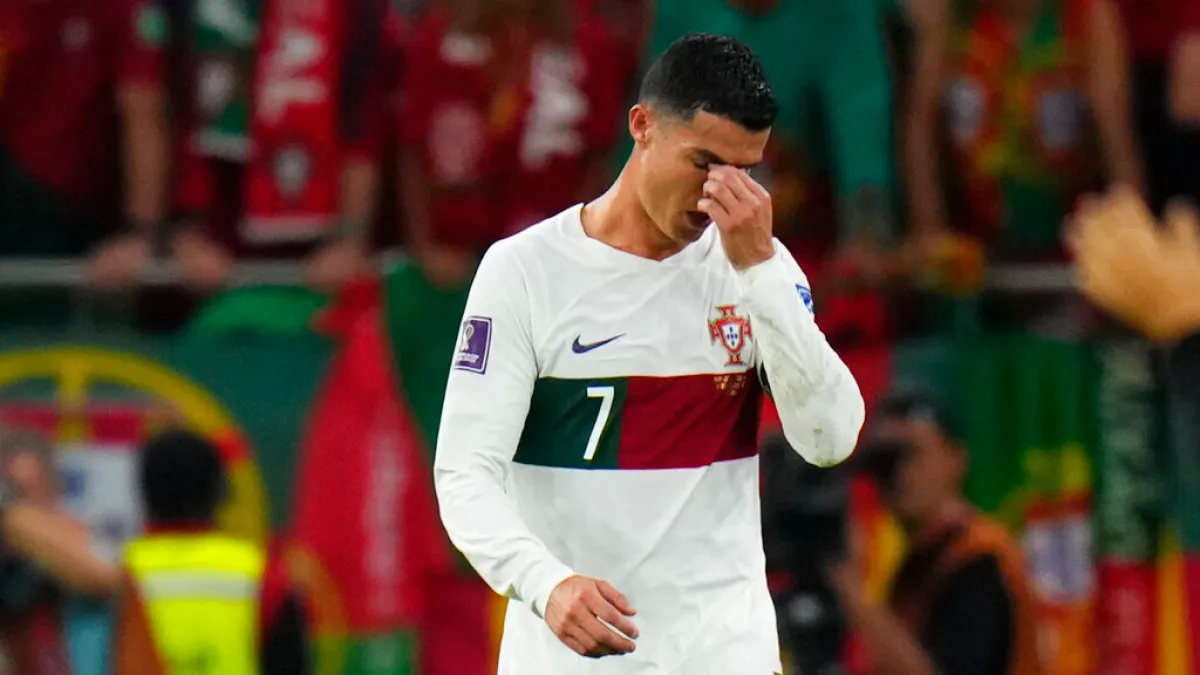
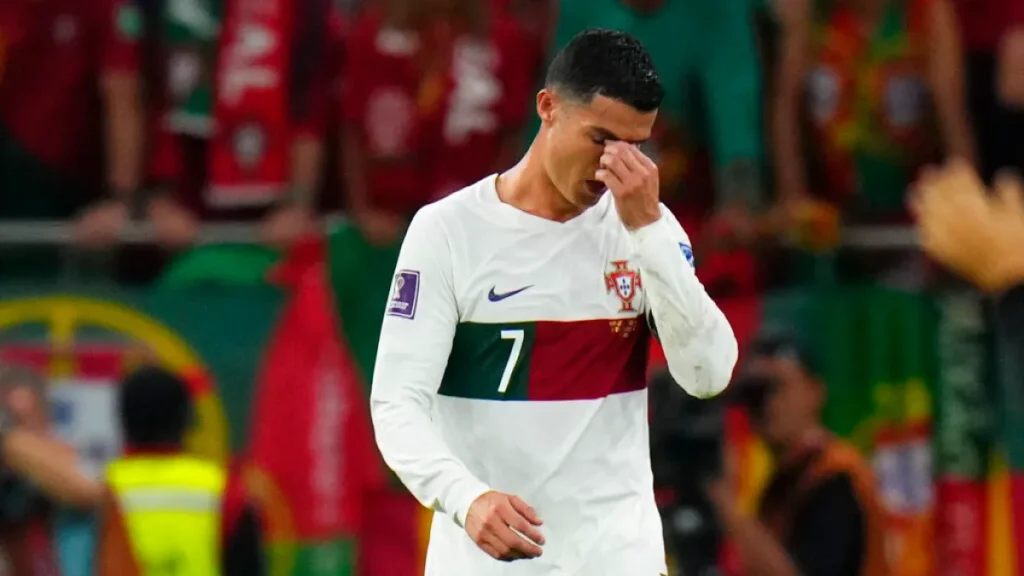
The 2022 World Cup in Qatar stands as the most recent and perhaps most painful chapter before this final one. By then, Ronaldo was in the twilight of his European club career, and Portugal’s campaign ended in a shocking quarterfinal defeat to Morocco. The image of a tearful Ronaldo walking alone down the tunnel captured a profound sense of a closing window. This history of near-misses and unmet potential is the essential backdrop for 2026. It establishes the World Cup not just as a missing trophy, but as the defining challenge of his career—the ultimate test he has yet to pass.
The Suspension Controversy: A Prelude to 2026
The road to Ronaldo’s last World Cup has not been without significant drama. In late 2025, a red card for violent conduct during a qualifier against Northern Ireland threatened to derail his participation before it began. The incident, an elbow on defender Dara O’Shea, typically carries an automatic three-match suspension, which would have ruled him out of Portugal’s crucial opening games in the 2026 tournament. This moment of on-field frustration suddenly cast his final mission into serious doubt, sparking global debate about discipline and legacy.
In a decision that ignited controversy, FIFA’s disciplinary committee handed Ronaldo a reduced, one-match suspended sentence. The governing body stated that the enforcement of two remaining matches was suspended for a probationary period of one year. This ruling was met with accusations of “double standards” from some quarters, with critics arguing another player might have received a harsher penalty. For Ronaldo and Portugal, however, Ronaldo’s last World Cup it was a reprieve. The controversy underscored the immense pressure surrounding his final campaign but ultimately cleared the path for him to lead his nation from the first whistle in 2026, Ronaldo’s last World Cup ensuring his last World Cup would not be compromised from the start.
The Unavoidable Comparison: Ronaldo and Messi’s World Cup Legacies
Any discussion of Ronaldo’s last World Cup inevitably involves his eternal rival, Lionel Messi. The 2026 tournament will also be Messi’s sixth, creating a parallel final chapter for the two defining players of their generation. The statistical contrast, however, Ronaldo’s last World Cup is stark and often cited in debates about their respective international impacts. Messi’s World Cup record includes 13 goals and 8 assists in 26 appearances, culminating in his crowning glory: lifting the trophy as captain in 2022. His performance in knockout stages has been particularly decisive.
Ronaldo’s World Cup statistics tell a different story. With 8 goals and 2 assists in 22 games, his output, while respectable, lacks the transformative knockout-stage moments. A deeper look reveals a critical gap: in eight World Cup knockout appearances, Ronaldo has registered 0 goals and 0 assists. This discrepancy in the tournament’s most pressure-filled moments is the central pillar of the narrative that Messi has triumphed on this ultimate stage while Ronaldo has not. The table below provides a clear, side-by-side comparison of their complete World Cup careers, highlighting the dimensions of their performances.
World Cup Career Comparison: Lionel Messi vs. Cristiano Ronaldo
| Statistic | Lionel Messi (Argentina) | Cristiano Ronaldo (Portugal) | Context & Significance |
|---|---|---|---|
| Tournaments Attended | 6 (2006, 2010, 2014, 2018, 2022, 2026) | 6 (2006, 2010, 2014, 2018, 2022, 2026) | Both will set a new record with a sixth appearance in 2026. |
| Total Appearances | 26 | 22 | Messi has played more total World Cup minutes (2,314 vs. 1,762). |
| Total Goals | 13 | 8 | Messi has a superior goals-per-game rate (0.50 vs. 0.36). |
| Total Assists | 8 | 2 | Highlights Messi’s greater creative influence in tournament play. |
| Knockout Stage Goals | 5 | 0 | The most critical differentiator; Ronaldo’s lack of goals in eliminators is a key narrative. |
| Knockout Stage Assists | 6 | 0 | Further underscores the disparity in impact during decisive matches. |
| Penalty Goals (Excl. SO) | 4 | 3 | Both are reliable from the spot in open play. |
| Man of the Match Awards* | 10 | 1 | Indicates how often each was the standout performer in a single game. |
Records on the Line in 2026
Beyond the quest for the trophy, Ronaldo’s last World Cup presents a final opportunity to etch his name in the record books in indelible ink. He stands on the verge of achieving several unique milestones that would further cement his status as a statistical titan. The most prominent is the chance to become the first player in history to score at six different World Cup tournaments. Having found the net in every edition from 2006 to 2022, a goal in North America would secure this singular achievement, a testament to his incredible longevity and sustained elite performance.
The record pursuit extends beyond the World Cup stage. As he approaches the tournament, Ronaldo continues his relentless march toward 1,000 official career goals for club and country—a mythical barrier no player has ever crossed. Furthermore, he is close to becoming the first player to score 500 goals after turning 30, a mind-boggling feat that underscores how he reshaped his game to dominate in his later years. Each goal in 2026 will thus carry dual significance: pushing Portugal forward in the tournament while also ticking off these personal, historic milestones. This blend of team ambition and individual legacy is the hallmark of his career’s final act.
Mindset and Motivation: The Fuel for One Last Campaign
Understanding the psychology driving Ronaldo toward his last World Cup is crucial. Publicly, he has made a surprising admission, seemingly downplaying the trophy’s importance to his legacy. “If you ask me, ‘Cristiano, is it a dream to win the World Cup?’ No, it’s not a dream,” he told Piers Morgan, arguing that his legacy is already secure regardless of the outcome. He stresses that his work in elevating Portuguese football—winning the Euros and Nations League—should not be overshadowed by a single competition.
Yet, those close to the sport hear a different tune. Former teammate Kleberson suggests a burning, internal fire. “Inside of him he probably feels ‘gosh, Ronaldo’s last World Cup I have to win the World Cup, I can’t finish my career like this’,” Kleberson observed. This dichotomy reveals the complex mindset of a champion. The public-facing stance protects against the immense pressure, while the private reality is likely a voracious, unquenchable hunger to complete his collection. Ronaldo’s last World Cup This final campaign is motivated by a deep-seated desire to silence the last remaining critics and to experience the euphoria that his rival Messi felt in 2022.
Portugal’s Contenders: The Supporting Cast for a Final Run
The success of Ronaldo’s last World Cup will not depend on him alone. Portugal boasts what is arguably the most talented squad of his international career, Ronaldo’s last World Cup a perfect blend of youthful exuberance and seasoned winners. Manager Roberto Martínez has a wealth of options at his disposal, from world-class creators like Bruno Fernandes and Bernardo Silva to a new generation of stars like Rafael Leão and João Neves. This depth allows Portugal to build a system that maximizes Ronaldo’s remaining strengths without being wholly dependent on them.
The strategic question for Martínez is how to best deploy his captain. At 41, Ronaldo’s last World Cup Ronaldo’s game has evolved from the explosive winger of 2006 to a consummate penalty-box predator. His role is likely to be that of a focal point—a leader, a finisher, Ronaldo’s last World Cup and a gravitational force that draws defenders and creates space for others. The supporting cast has the quality to supply him and to capitalize when attention shifts his way. This balance between venerating a legend and deploying him as part of a modern, cohesive unit will be Portugal’s greatest tactical challenge and the key to unlocking a successful campaign for his last World Cup.
Legacy in the Balance: How 2026 Shapes the Final Judgment
The concept of legacy is the gravitational center of Ronaldo’s last World Cup. He himself has questioned the fairness of having a career judged by one trophy, arguing, “To define [me] at 40 years old, 41? To define what? To win one competition, six games, seven games? You think it’s fair? It’s not fair”. By any objective measure, his legacy as one of the greatest players ever is unassailable. His five Ballon d’Or awards, five Champions League titles, and status as the all-time leading scorer in men’s international football are pillars of an immortal career.
However, football narratives are rarely purely objective. The World Cup’s unique, global resonance means that a victory in 2026 would qualitatively alter his story. It would transform the narrative from “the unparalleled winner who never won the biggest one” to “the complete champion who triumphed in his final act.” It would be the ultimate rebuttal to his critics and a storybook ending of unparalleled drama. Conversely, another defeat, particularly if Portugal falters early, would cement the World Cup as the conspicuous void in his trophy cabinet. While it wouldn’t diminish his achievements, it would permanently frame them within a context of “what if.” His last World Cup is, therefore, the final edit on a legendary story still being written.
The Final Whistle: Embracing the Last Dance
As the football world converges on North America for the 2026 World Cup, all eyes will be on Cristiano Ronaldo for one last, historic dance on the global stage. This tournament represents more than a competition; it is the closing ceremony for a 20-year international odyssey that inspired millions and redefined excellence. Whether he lifts the trophy or not, his final World Cup will be a moment of profound reflection on a career built on relentless work, audacious goals, and an unwavering will to win.
In the end, Ronaldo’s last World Cup is a gift to the sport—a chance for fans to witness the final chapter of a living legend. The pressure is immense, the history is weighty, and the challenge is monumental. Yet, if there is one athlete equipped to thrive under such conditions, it is Cristiano Ronaldo. He will step onto the pitch not just as a player, but as an icon chasing the final, missing piece of his legacy, ready to write the conclusion to his own epic story. As he noted about his eventual retirement, “It will be very, very difficult… I probably will cry”. In 2026, a whole sport might just join him, celebrating not just an ending, but the incredible journey that led to Ronaldo’s last World Cup.
Frequently Asked Questions About Ronaldo’s Last World Cup
Has Cristiano Ronaldo officially confirmed the 2026 World Cup is his last?
Yes, he has made a definitive confirmation. In late 2025, Ronaldo stated in an interview, “Definitely, yes,” when asked if the 2026 tournament would be his last, citing that he will be 41 years old by then. He has concurrently indicated that his overall retirement from professional football will likely follow within “one or two years” after that.
What are Portugal’s chances of winning the 2026 World Cup with Ronaldo?
Portugal is considered among the top contenders. They possess one of the most talented and balanced squads in international football, featuring a mix of experienced stars and elite young players. This strong supporting cast, combined with Ronaldo’s enduring goal threat and leadership, makes Portugal a serious threat to win the title during Ronaldo’s last World Cup.
What major records can Ronaldo break at the 2026 World Cup?
The most prominent record within reach is becoming the first player ever to score in six different World Cup tournaments. Furthermore, the tournament will be a key stage in his pursuit of the all-time milestone of 1,000 official career goals, a feat he is intensely motivated to achieve before retiring.
Was Ronaldo ever at risk of missing the 2026 World Cup?
Yes, briefly. Following a red card for violent conduct in a 2025 qualifier, he faced a potential multi-game suspension that could have sidelined him for the start of the tournament. However, FIFA reduced the ban to a one-match suspended sentence, allowing him to be available for Portugal’s opening match and ensuring his participation in his last World Cup was not jeopardized.
What has Ronaldo said about the importance of winning the World Cup to his legacy?
Ronaldo has presented a nuanced view. Publicly, he has argued that winning the World Cup should not define his legacy, stating that his career achievements and his role in winning Portugal’s first major titles already secure his place in history. However, former teammates and analysts believe that internally, winning the trophy is a powerful, driving motivation to complete his collection of honors.