


Live Action Moana: Everything You Need to Know About the 2026 Voyage
When Disney first announced that Moana would receive the live action treatment, fans around the world held their breath. The 2016 animated film had become a cultural touchstone, celebrated for its breathtaking ocean visuals, empowering story of a young wayfinder, and the unforgettable music of Lin-Manuel Miranda. Translating that magic into a real world setting is no small challenge, but the studio has approached this adaptation with genuine care and ambition. Rather than simply recreating every frame, the creative team has focused on expanding the world of Motunui, using practical locations and human performances to add new layers of depth to a story we already love.
The decision to move forward with this project came after years of fan demand and the realization that live action could offer something the animation could not: tangible texture. The way sunlight hits the water, the grain of a wooden canoe, and the physical exhaustion of climbing a mountain are all elements that resonate differently when captured by a camera on location. Disney has learned from previous live action remakes, and with Moana, they have prioritized authenticity over spectacle. Early footage suggests a film that respects its source material while daring to feel fresh, grounding the mythical elements of Maui and the ocean in a reality that audiences can almost reach out and touch.
Another key factor in this transition is the passage of time. The original film was released nearly a decade before this adaptation hits theaters, which means a new generation of children has grown up with Moana as a hero. For them, seeing a real person embody that bravery is deeply moving. For adults who watched the original in theaters, the live action version offers a chance to revisit the story with older eyes, noticing the cultural details and emotional beats that might have been missed the first time. This dual appeal is what makes the project not just a remake, but a meaningful retelling.
Catherine Laga’aia Steps into the Shell Necklace
The most pressing question for any live action remake is always about the lead actor, and Disney surprised many by choosing a relative newcomer for the role of Moana. Catherine Laga’aia, a young actress of Samoan and Australian heritage, was cast after an extensive global search that saw thousands of young women audition for the part. What set Laga’aia apart was not just her singing voice, which carries the same powerful yet vulnerable quality as Auli’i Cravalho’s original performance, but her physical presence. She moves like someone who has grown up near the ocean, with a natural confidence that makes her believable as a future chief of her people.
Laga’aia has spoken in interviews about the weight of taking on such an iconic role, especially knowing that young Pacific Islander girls will be watching her closely. She underwent months of training in swimming, canoe handling, and traditional navigation techniques to prepare for the physically demanding shoot. The production did not rely on stunt doubles for the majority of her ocean scenes, meaning Laga’aia spent hours in the waters off Oahu, battling wave machines and learning how to make the action look effortless. Her chemistry with Dwayne Johnson was reportedly instant, with the two developing a playful rapport that mirrors the bickering yet loving dynamic between Moana and Maui.
Early reactions from test screenings, which have been kept tightly under wraps, suggest that Laga’aia is the breakout star of the film. Critics who have seen rough cuts describe her performance as raw and heartfelt, particularly in the quieter moments where Moana doubts herself. One insider reportedly said that her rendition of the reprise of “How Far I’ll Go” brought members of the production team to tears. For a young actress carrying a two hundred million dollar film on her shoulders, that is high praise. Laga’aia is not trying to copy Cravalho’s performance; she is building something new from the same foundation, and that authenticity is what will win over skeptical fans.
Dwayne Johnson Brings Maui to Life in Person
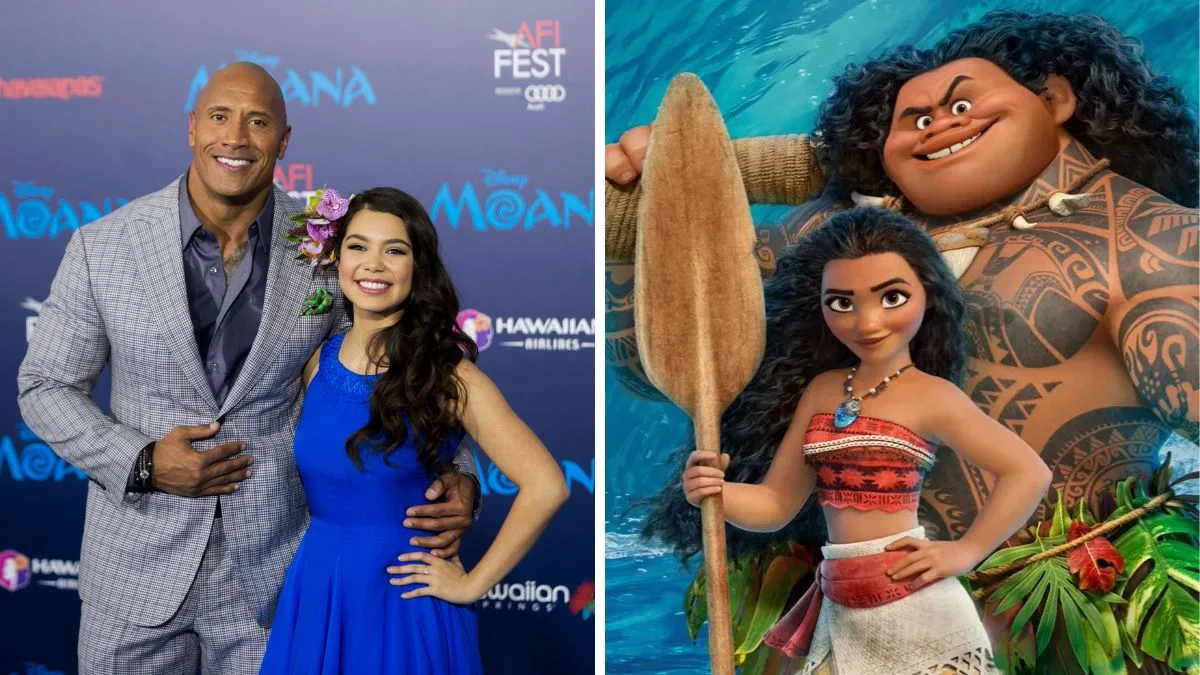
Dwayne Johnson has played many larger than life characters throughout his career, but Maui holds a special place in his heart. The demigod of the wind and sea, with his shape shifting abilities, living tattoos, and massive fish hook, was originally voiced by Johnson in the animated film. Returning to play the character in live action required a different kind of preparation. Johnson had to undergo a rigorous physical transformation, adding lean muscle to match the exaggerated physique of the animated Maui while still looking like a real human being. The result is impressive: Johnson appears broader and more imposing than ever, but his performance adds a vulnerability that animation could only hint at.
The most fascinating technical achievement of the live action Maui is the tattoos. In the animated film, Maui’s tattoos moved and danced across his skin, telling the story of his heroic deeds and his insecurities. Recreating that effect in live action required a combination of practical makeup and cutting edge visual effects. Johnson wore hundreds of prosthetic tattoo appliques on his arms, chest, and back, each one painstakingly painted by hand. During post production, animators then brought specific tattoos to life, allowing the mini Maui character to interact with the real Maui in a way that feels organic rather than cartoonish. Johnson has joked that the tattoo application process added two hours to his daily makeup routine.
Beyond the physical demands, Johnson has infused Maui with a new emotional depth. The animated Maui was brash and arrogant, hiding his fear of losing his hook and his status. In the live action version, those moments of vulnerability are more pronounced. There is a scene, reportedly shot in a single take, where Maui admits to Moana that he was abandoned by his human parents as an infant. Johnson delivers this confession with a quiet sadness that reminds audiences that even demigods carry scars. This grounded approach to the character ensures that Maui is not just comic relief or a muscle bound sidekick, but a fully realized being on his own journey of healing.
The Returning Icons and New Faces of Motunui
While the leads capture the headlines, the supporting cast of the live action Moana is equally impressive and carefully chosen. John Tui, known for his roles in action films and television series, takes on the role of Chief Tui, Moana’s protective and stubborn father. Tui brings a deep, resonant voice and a physical presence that makes his fear of the ocean feel like a trauma rather than mere stubbornness. His scenes with Catherine Laga’aia are reportedly some of the most emotionally charged in the film, particularly a flashback sequence that shows a young Tui losing a friend to the sea, which explains his desperate need to keep Moana on the island.
Frankie Adams plays Sina, Moana’s mother, and she provides the warmth and quiet strength that balances Tui’s rigidity. In the animated film, Sina had relatively few lines, but the live action version expands her role significantly. Adams has described Sina as the emotional anchor of the family, the one who sees Moana’s destiny before anyone else and gently guides her husband toward acceptance. There is a beautiful scene where Sina gives Moana her grandmother’s necklace, explaining that the women of their family have always heard the ocean’s call, but fear kept them ashore. That moment gives Moana the permission she needs to leave, and Adams delivers it with a tearful smile that will resonate with any parent watching their child grow up.
Perhaps the most poignant casting is Rena Owen as Gramma Tala. The village elder, who dances with the waves and speaks to the spirits, is the heart of the original film. Owen, a veteran actress of Maori heritage, brings a mystical gravitas to the role. Her Gramma Tala is not just eccentric; she is a woman who has seen the future and is racing against time to prepare her granddaughter for it. The live action format allows Owen to use subtle facial expressions and hand gestures that animation could not capture. In her final scene, where she transforms into a manta ray, the visual effects team blended Owen’s real performance with CGI so seamlessly that it feels like watching actual magic unfold on screen.
Thomas Kail Directs with a Theatrical Vision
Choosing the right director for a musical fantasy epic like Moana was crucial, and Disney made an inspired choice in Thomas Kail. Best known for directing the Broadway phenomenon Hamilton, Kail had never helmed a feature film before this project. However, his background in live theater proved to be an unexpected advantage. Kail understands how to stage musical numbers so that they feel organic to the story rather than interrupting it. He also knows how to capture the energy of a live performance, keeping cameras rolling for extended takes that allow actors to build emotional momentum across an entire song rather than chopping it into tiny pieces.
Kail’s approach to the action sequences is also unique. Rather than relying on rapid fire editing and shaky camerawork, he favors wide shots that show the geography of a scene. The ocean voyage sequences, for example, are shot with a combination of drone footage and cameras mounted on floating rigs, allowing the audience to see Moana and Maui in the canoe together while the water churns around them. This creates a sense of real danger and real space. When the Kakamora coconut pirates attack, we see the entire battle unfold in long takes, making the chaos feel organized rather than confusing. Kail has cited classic adventure films like Raiders of the Lost Ark as influences, and that influence shows in the clarity of his action staging.
Perhaps most importantly, Kail has prioritized the musical performances. He insisted that all actors sing live on set rather than lip syncing to prerecorded tracks. This decision required a massive effort from the sound department, which had to capture clean audio while waves crashed and wind machines roared. But the result is palpable. When Laga’aia sings “How Far I’ll Go” while standing on the bow of the canoe, we hear the strain in her voice from the physical exertion of sailing. When Johnson belts “You’re Welcome,” we hear the breathlessness of a demigod who is also trying to impress a skeptical teenager. These imperfections make the music feel real, and that realism is the secret weapon of Kail’s direction.
Filming Across Two Worlds: Hawaii and Georgia
The decision to film the live action Moana on location rather than entirely on a soundstage was a bold and expensive one. The production split its shooting between two very different environments: the beaches and valleys of Oahu, Hawaii, and the studio lots of Atlanta, Georgia. The choice of Poka’i Bay in Oahu as the primary location for Motunui was deliberate. This crescent shaped beach, with its gentle waves and lush green mountains rising behind it, had never been used for a major film production before. The crew built the entire village of Motunui on the shore, constructing thatched huts, a ceremonial boat house, and a winding path up the hillside where Moana first sees the ocean.
However, filming in Hawaii presented significant logistical challenges. The weather is unpredictable, with sudden rain showers that could halt production for hours. The crew had to work around the schedules of local wildlife, including nesting sea turtles and endangered monk seals. Additionally, the production made a commitment to hire local Hawaiian and Pacific Islander crew members whenever possible, which required training programs and extended timelines. Despite these difficulties, the cast and crew have spoken about the spiritual experience of filming in such a pristine environment. Catherine Laga’aia described walking into the village set for the first time and breaking down in tears because it felt like stepping into her grandmother’s memories.
The Atlanta portion of the shoot focused on interior sets and specific landscape features that Hawaii could not provide. Sweetwater Creek State Park, located just outside Atlanta, doubled for the dense jungle where Moana confronts the coconut pirates. The rocky outcrops and fast moving creek of the park matched the visual references from the animated film almost perfectly. Meanwhile, soundstages in Atlanta housed the massive interior of Maui’s hook, the cavern of Tamatoa the giant crab, and the fiery lair of Te Kā. This split location strategy allowed the filmmakers to capture authentic sunlight and ocean spray for the exterior scenes while maintaining complete control for the visual effects heavy sequences. The final film seamlessly blends these two worlds, and most viewers will never notice the transition.
The Music Returns with Lin-Manuel Miranda
No discussion of Moana is complete without celebrating its music, and the live action version brings back the dream team. Lin-Manuel Miranda, Opetaia Foa’i, and Mark Mancina have reunited to oversee the soundtrack, with Miranda returning after his absence from the animated sequel. The trio spent months deciding which songs to keep, which to cut, and where to write new material. Ultimately, they decided to retain all of the major songs from the original film, including “Where You Are,” “We Know the Way,” and “I Am Moana,” but each has been re orchestrated for the live action setting. The tempos are slightly slower in the intimate scenes and faster in the action sequences, matching the rhythm of real human movement.
The most significant musical change is the addition of two new songs. One is a duet between Moana and Maui that takes place during their night journey through the Realm of the Monsters. The song, titled “Pull the Rope,” explores their growing trust and mutual respect, with Miranda’s lyrics weaving sailing terminology into a metaphor for emotional vulnerability. The other new song is a solo for Gramma Tala, performed by Rena Owen, titled “The Ocean Knows Your Name.” This haunting ballad plays during a flashback to Tala’s youth, explaining why she chose to stay on Motunui rather than follow her own wayfinding dreams. It is a devastating moment that adds backstory to a character who was already beloved.
Mark Mancina’s score has also been expanded. The live action format allowed Mancina to record with a larger orchestra and to incorporate more traditional Pacific Island instruments, including the pahu drum, the nose flute, and various shell trumpets. The main theme, which plays whenever the ocean interacts with Moana, has been given a softer, more mysterious arrangement. In the animated film, the ocean was a playful character. In this version, it feels more ancient and unknowable, a force of nature rather than a cartoon sidekick. This tonal shift in the music reflects the overall approach of the live action adaptation: respectful of the original but willing to evolve.
Cultural Authenticity at the Forefront
Disney faced legitimate criticism in the past for superficial cultural representation, and the studio was determined not to repeat those mistakes with Moana. From the earliest stages of development, the production employed a council of Pacific Islander advisors, including historians, linguists, master navigators, and tattoo artists. This council had veto power over script decisions, costume designs, and even casting choices. Their influence is visible in every frame of the film. The wayfinding sequences, for example, were choreographed by a real master navigator from the Marshall Islands, who taught the actors how to read swells, star positions, and bird flight patterns with authentic accuracy.
The language of Motunui is another area where the live action film goes deeper than the original. While the animated film used some Tokelauan and Samoan phrases, the live action version features extended conversations in Polynesian languages, with English subtitles. The production hired dialect coaches to ensure that the actors’ pronunciations were flawless. Catherine Laga’aia learned specific phrases in Samoan, while John Tui delivered several of Chief Tui’s speeches entirely in Tongan. This decision was not made for marketing purposes but out of genuine respect for the cultures that inspired the story. The response from Pacific Islander communities has been overwhelmingly positive, with many leaders praising Disney for finally getting the details right.
Costume design was another area of intense cultural consultation. The film’s costume designer worked closely with weavers and textile artists from Fiji, Samoa, and Hawaii to create garments that were historically accurate rather than Hollywood fantasies. Moana’s signature red dress, for example, is made from hand pounded barkcloth using traditional methods, dyed with natural pigments, and adorned with cowrie shells that hold specific spiritual meanings. Maui’s loincloth incorporates feathers from birds that are sacred in Hawaiian mythology. Even the tattoos on the background villagers were carefully researched, with each symbol telling a true story about the actor’s own heritage. This attention to detail transforms the live action Moana from a simple remake into a document of cultural preservation.
Release Date and What to Expect in Theaters
The live action Moana is scheduled to sail into theaters on July 10, 2026, positioning it as the centerpiece of Disney’s summer blockbuster lineup. This release date was chosen carefully to maximize family audiences, as July is a prime month for school vacations and group outings. The film will be released exclusively in theaters, with a traditional window of approximately ninety days before it becomes available on the Disney Plus streaming platform. Disney is betting heavily on the theatrical experience for this film, as the sweeping ocean vistas and immersive sound design are best appreciated on the largest screen possible. Early box office tracking suggests an opening weekend north of one hundred twenty million dollars domestically.
For parents wondering about age appropriateness, the live action Moana retains the PG rating of the original. However, the visual realism does make some sequences more intense. The battle with Te Kā, the volcanic monster, is genuinely frightening in live action, with flames that look real and a creature design that emphasizes sharp angles and glowing fury. Similarly, Tamatoa the giant crab, voiced by Jemaine Clement in a returning cameo, is more grotesque and unsettling than his animated counterpart. Young children may find these moments overwhelming, and the film is best suited for viewers aged six and above. That said, the emotional payoff of Moana restoring the heart of Te Fiti is even more moving in this version, and the final shot of the ocean parting for her return to Motunui is breathtaking.
The runtime of the live action Moana is approximately one hundred thirty five minutes, which is about twenty minutes longer than the original. Those extra minutes are distributed throughout the film, adding depth to supporting characters, expanding the voyage sequences, and allowing musical numbers to breathe. There is also a post credits scene that has been kept tightly under wraps, but rumors suggest it teases a potential live action sequel or a connection to the animated Moana 2. Whether those rumors prove true or not, audiences should plan to stay in their seats until the very end. The ocean is calling, and on July 10, 2026, we finally get to answer.